Gaining a Fitbit has me losing (weight)

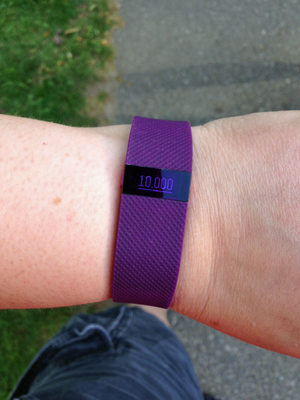
Getting love from my Fitbit ChargeHR upon reaching 10,000 steps

Getting love from my Fitbit ChargeHR upon reaching 10,000 steps

A few years back, I took part in a wellness competition that pitted co-worker against co-worker, trying to see who could get the most steps. People were organized in teams, and we were given these exceptionally junky (but free!) pedometers that we clipped onto ourselves as a way to measure our movement.

It totally stressed me out. I hated it.

Here’s the thing: as a new person at my company, and wanting to take advantage of my employer’s encouragement to be healthier, the competition gave me a great incentive to get up and move myself out of my cubicle. It also gave me a sense of belonging, even if only to commiserate with fellow pedometer-wearing folk who similarly hated the clunky, clearly-worth-the-free-price devices. I bowed out after doing a couple of these competitions in a row; I couldn’t handle the stress of keeping up with co-workers who had A LOT more time to work out every day, and I truly HATED wearing the pedometer. I could never seem to find a place to wear the device where it would measure my steps accurately on a consistent basis, and woe unto me if I forgot to put the thing on, since we had to log our steps daily.

But the thing is, I still wanted to be healthier, and that’s been a constant struggle. Movement during the day can be really difficult, especially when you work in an office environment where the majority of “active” time is when you’re going between floors or rooms for meetings.

Enter Fitbit.

I have friends with Fitbit devices, and I’ve seen them sported by several co-workers. They talked about how great it was to strap the thing on and not really think about it; their steps were just recorded for them. Feedback happened when you hit a step goal that YOU set, and the price wasn’t heinous.

After much hemming and hawing over which features were most important to me, I settled on the Fitbit Charge HR. I wanted it to count flights of stairs (to encourage me to skip the elevator), and I really liked that it had a wristband more like that of a watch. Facebook friends and page followers also told me that they’d had better luck with the Fitbit Charge HR‘s wristband than that of the Fitbit Flex (something about breaking?!), so that also pointed to the Fitbit Charge HR.

So I got one. And I LURVE it.

I’ve had mine for about a month now, and it’s gotten me to MOVE more just by its being on my wrist. That doesn’t mean it buzzes at me when I’m sedentary for a stretch (which would be a nifty feature, btw); I mean that its very presence is a physical reminder that I’ve made a promise to myself to be healthier. Thus far, it has been working: I’m taking the stairs more at the office than before I got my Charge HR, and I’m more motivated to find ways to get to 10,000 steps for as many days as I can. That number is still not nearly as many days as I’d like but–baby steps. Without some kind of step counter I just didn’t have a good baseline for what a “normal” day in my life looked like anymore, and it’s impossible to measure progress without knowing your starting point.

It also helps that it’s easy to use. Setup instructions are minimal; you download the app to your phone and it walks you through everything (including getting an account set up on the Fitbit website). Once this is all set, the device synchronizes data wirelessly using Bluetooth, so the cumbersome data entry of those prior years’ competitions is never happening again. Even better, I get real-time feedback on the device and on the app.
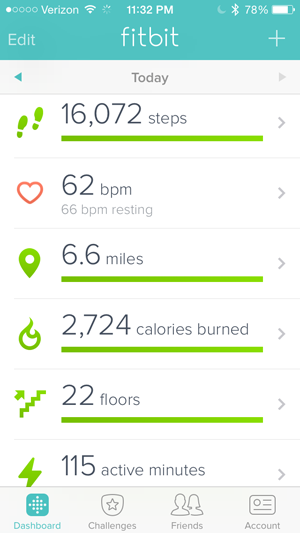
 

A recent Sunday, often my most active steps day

A recent Sunday, often my most active steps day

In general, I’ve found that the Fitbit Charge HR solves three problems for me:

  1. I can’t forget it – with a clock of its own, I wear my Fitbit instead of a watch.
  2. I don’t struggle finding a place to wear it – it goes on my wrist and stays securely there.
  3. I don’t have to fuss with logging steps – that’s done automatically by the device, which sends the info to the app (which then sends the info to the website).

One area of improvement for Fitbit would be a longer charging cable; it’s designed for charging with your computer, and I charge my devices with the wall instead. (This problem was easily solved by buying an inexpensive USB Extension Cable from Amazon).

The result of my Fitbit experiment: I’m making more progress in my weight loss.

So that’s really the big test, right? If you’re starting to see that you’re passing a plateau mark, that’s a good sign. In my case, the first inkling that I’d reached a turning point was when my clothes (particularly those for work) were hanging off me. The next point that it clicked for me was when I went to the doctor’s office for my physical and she told me that I’d lost 17lbs since my exam in 2014. Sure, a good bit of that was done pre-Fitbit-purchase, but I’d plateau’ed a couple of months ago and needed help getting my weight loss going again.

I won’t say that a Charge HR can do this for everyone. Honestly, if the motivation isn’t there, there’s no amount of wearable tech that’s going to make it happen. And I’m not losing crazy amounts of weight where I’m dropping a dress size a week or something. The Fitbit is just helping me keep track of where I was and giving my wrist a gentle hug when I make my daily goal.
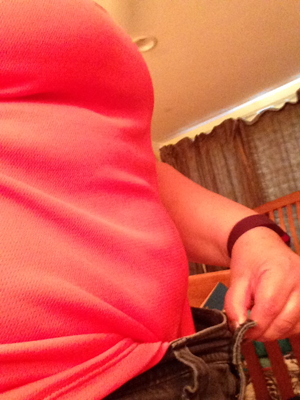
My tight shorts aren't so tight anymore.

My tight shorts aren’t so tight anymore.


In the past month, I’ve dropped an inch or two from my waist, to the point where my “tight waist” shorts now barely hug my hips. I’ve lost 3.5lbs, about one pound per week (which is a totally healthy amount to lose per week). All in all, it’s pretty incredible.

I can’t wait to see what the next month brings.


Confessions of a soccer-mom (not a “soccer mom”)

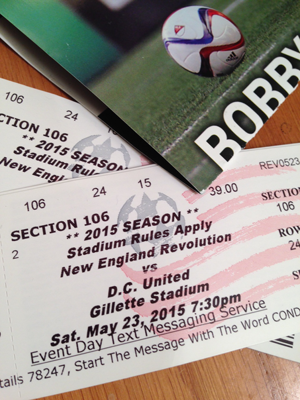
tickets

When I moved to the Boston area in 1997, I almost immediately fell in with a crowd of fellow footy-lovers. I’d gained an appreciation for the sport when a co-worker helped me score tickets for the entire slate of soccer games played at RFK during the 1996 Summer Olympics. Add to that the thrilling DC United victory in the first-ever MLS Cup Final, and I was hooked. Later, I would met dh through soccer, at a pick-up game no less (no, not THAT kind of pick-up), making “the beautiful game” a critical component of my life for the better part of the past twenty years.

For a number of years after I moved up, footy had a dominant role in my life. Game weekends ruled my calendar, and even Sunday morning brunch with my group of game-going friends was somewhere that had a large screen for watching more matches. I was a proud season ticket holder of the New England Revolution, moving along with the rest of the Midnight Riders in The Fort from the metal benches of the former Foxboro Stadium to the plastic static-inducing-seats-with-cupholders of Gillette Stadium. As a die-hard, I traveled for games, I stood in sometimes torrential rain at our home field, and I watched (and took part in the fun) as tailgating was elevated to an art form.

And then life got way more complicated.

Within the span of a twelve-month period, my then-boyfriend and I bought a house, we got engaged, I started (night-time) graduate school, and we got married. Finances and calendar space became tighter pretty much immediately, so our game-going became more sporadic. I can’t count the number of weekends I spent with my laptop on my lap, homework spread out all over a couch, as a game was on in the background.

Then kids happened.

About a year and a half after I earned my Masters degree, dd was born. Finances that were previously tight shrank horribly. Day care expenses dominated our checkbook, costing well over $300 each week. Between money being so tight and having a newborn who demanded all the attention there was, going to games faded into the background.

More time passed, and just under three years after his big sister made her first appearance, ds was born. Money got even tighter. Day care now commanded well over $600 per week from us, enough so that there was a point in time when I sincerely considered just staying home in order to staunch the fiscal bleeding–but I still made enough to make it financially worthwhile to continue working outside the home. It was my preference to continue working anyway, and so we forged on.

And so did the rest of the group, albeit in their own ways. Over the course of time, several people from our group left town–migrating elsewhere in the Northeast or Mid-Atlantic regions–and some faded from view as other matters in their lives took precedence. A group of die-hards still continues to this day, but their number is greatly diminished, with so many of us scattered, focused on different priorities than the game.

That’s not to say that dh & I don’t watch matches; we do. It’s just that making an appearance at the games has always been something that’s had a profoundly different effect on me than just watching the game at home. Even when the atmosphere was awful, with The Fort being the only noise in the whole damn cavernous hulking beast that is Gillette Stadium, the tailgate and seeing my friends always made it an experience. I distinctly remember a point when the Revolution was nowhere near the top of the standings, and our attempt to tailgate through the entire game was stymied by the security team “kicking us into” the stadium.

And yet, I don’t regret anything.

I still have yet to see a World Cup match in person, either on foreign or domestic soil (I missed my chance to get World Cup ’94 tickets with my co-workers, because I started that job right as the World Cup began). I haven’t traveled to a Rev match (or any other sporting event outside New England) in years. I’ve seen two Revolution games in person this season, and that’s more than I’ve seen in the last several years combined.

Major League Soccer is trying to manage the needs of two somewhat competing elements. On the one hand, they want to cater to the “soccer moms”–the ones who have inroads with youth teams that can “put fannies in the seats” (as former Revolution General Manager and WGBH host Brian O’Donovan used to say)–but on the other hand, they want to cultivate the more grown-up European atmosphere on display in cities like Seattle and Portland. It’s difficult to organize a “family-friendly” experience and also have the supporters chanting “YOU SUCK!!!” at the opposing goalkeeper each time he kicks the ball. Then again, it’s also hard to fill the seats with the younger set when many games don’t start until 7:00 or 7:30pm, guaranteeing that younglings will be going to bed late.

This was a lot of what kept us away in the past couple of years (along with the crippling, now-gone day care costs), and we knew the epic meltdowns of keeping our kids up late weren’t worth it. As parents, you sense what’s worth the fight and what’s not, and that just wasn’t. With ds nearing the age of six, we’re within striking distance of this being okay, so we’ve dipped our toes in the water of coming back to the stadium–first with an afternoon game, then with a night game. In both cases, the kids loved it. The other night, ds proudly held my scarf high above his head as the team came out onto the field. He and his sister both sported matching Revolution shirts and hats that they proudly showed off before, during, and after the game.

And the tailgate. Oh the tailgate. They loved the tailgate. We hung out with our die-hard friends before the game, and afterwards we treated friends both old and new to S’mores. We didn’t get home until after 11pm, and the kids were tired but happy. When asked if they wanted to go back, the answer was an unequivocal “Yes!”

So I sit with my laptop open, pondering a mini-plan or some other method of getting a small slate of tickets for us, not yet ready for The Fort with the kiddos until I can be sure any language they learn to repeat can as easily be attributed to us as to their friends at school. (I’m figuring five years.) I’d like to get us back on a trajectory of being a part of that world again, because it was so instrumental in me finding something beautiful.

I regret not one moment that I spent at home instead of at a game, because my children and my family matter more to me than any team. I chose them as my priority, and I’m sure I made the right decision. And now, with my kids bitten by the footy bug as I was at a much later age, I’m glad I can be there to see the looks on their faces each time it’s new.

DD asked when we can get tickets for The Fort, and she also (separately) asked if she can become a season ticket holder. I’d like to say, “My work here is done!” and just pat myself on the back, but I know it’s only the beginning of their journey. And it’s going to be one hell of a great ride.

Movie Review: “Tomorrowland”

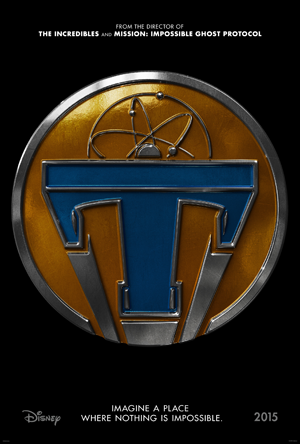
Tomorrowland

“This is a story about the future, and the future can be scary” — the somewhat ominous first words from John Francis “Frank” Walker (George Clooney), at the opening of Brad Bird’s latest opus. Rather than bringing us straight to the shiny future teased in the movie’s trailers, “Tomorrowland” truly begins with a visit to the past, 1964 to be exact, and the World’s Fair in New York. Young Frank (Thomas Robinson) makes his appearance at a booth for the vetting of inventions, and when a taciturn Nix (Hugh Laurie) seems to find every reason to turn down Frank’s only-barely-not-working jet pack, a sweet young pixie named Athena (Raffey Cassidy) chases him down and coyly offers him a second chance to impress with his technology.

Athena hands Frank a pin with a “T” on it and orders him to follow her from a safe distance, while she then dashes ahead to the “It’s a Small World” ride (which actually debuted at the real-life 1964 Fair). Frank manages to scamper onto one of the boats and the pin ensures that he’s spirited away to a world straight out of every futuristic drawing ever produced (or perhaps from the pen of the designer of London’s Shard), where his jet pack manages to save his life almost immediately upon arrival. Frank and Athena are soon reunited and, as much as Nix dourly regards Frank, he’s unable to deny that Frank has some techno skills.


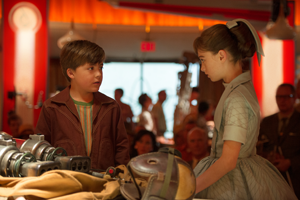
Young Frank and Athena at the World's Fair

The younger Frank (Thomas Robinson) talking about his jet pack with Athena (Raffey Cassidy)


Skip now to present day, where Casey Newton (Britt Robertson) is trying to sabotage the demolition of a NASA launch platform at Cape Canaveral to stave off a future that puts her engineer father out of work. “It’s hard to have ideas…and easy to give up,” she says. Given how the rest of the movie goes, I’m inclined to agree with her. Over the course of the two hour and ten minute-long film, Casey goes on your standard hero quest through space and time–to the point where I started to wonder if Bird himself gave up and just dropped scenes and concepts from “Back to the Future II”, “Percy Jackson & the Olympians: The Lightning Thief”, “Contact”, and “The Lorax” into the largest blender he could find.


Casey in the wheat field

Casey (Britt Robertson) seemingly transported to a field wheat


A strangely un-aged Athena plants a pin on Casey, who soon discovers that it has the power to show her a transformed world with the lovely dichotomy of a super-futuristic city surrounded by fields of completely untended wheat. As it happens, the pin is merely an ad; it shows Casey the visuals but none of it is real. When the time runs out on the hallucination (or very intricate hologram), she finds she’s mostly waded into a swamp. One quick internet search later, she finds a place that may have answers about the vision from the pin: a nerdtopia of a store called “Blast from the Past”, run by Ursula (Kathryn Hahn) and Hugo (Keegan-Michael Key).

It’s once you get to “Blast from the Past” that “Tomorrowland” veers firmly off the “OK for Small Kids” path, when a variety of killbots sporting hyper-bleached toothy grins begin the first of several lengthy appearances, blowing up things left, right and center, and placing Casey firmly in danger. Athena helps save the teenaged heroine, aiding her escape and setting her on the path to meeting up with Frank, at which point the strange story takes turns both predictable and disappointing.


Frank and Casey in Frank's house

Older Frank (George Clooney) and Casey (Britt Robertson) having one of many arguments


The pairing of Casey and Frank goes well enough, but at this point the story itself becomes too much of an unoriginal hot mess to match with some of Bird’s earlier work (such as “The Incredibles”, which is Bird and Pixar both firing on all cylinders). As much as Frank initially resists Casey’s pleas for help to get to the city of the pin’s visions, he soon wholeheartedly jumps into her quest and all too slowly reveals why it is that he no longer resides in the utopia she glimpsed. The remaining threads of the story then pull together in a manner well-telegraphed to those paying attention.

On the plus side, the casting was fairly well done. Robertson is plucky and adorable (sort of a Jennifer Lawrence-lite), and Clooney plays “get off my lawn” rather well for someone who started out his career as a heart-throb. Cassidy plays Athena just right, and the combination of Key and Hahn needs to get its own TV show (or she needs to be a regular on “Key and Peele”). The visuals of the shiny city with multilevel pools and flying everything are gorgeous, although occasionally the green screening doesn’t quite work as well as it should.

Where “Tomorrowland” falls below expectations is in how often it spends too much time wallowing in misery over discarded gadgets and people, showing the myriad ways one can disable a grinning killbot, and lecturing everyone on how little we appreciate everything around us. Meanwhile, it gives short shrift to the future promised by the eponymous “land”, in particular leaving a whole piece of what’s happening in that city completely unexplained, and the writers maddeningly deny Laurie’s Nix the opportunity to chew all the scenery within reach. Talk about not appreciating something right in front of you.

As far as the question of whether “Tomorrowland” is okay to watch with kids, I’d recommend it for children 8 years or older. Below that age, some of the violent scenes may be too disturbing. It’s actually somewhat difficult to tell which age range is the target for “Tomorrowland”, since portions of it are fairly kid-oriented but the action scenes are really too much for the smaller set. Perhaps all that jumping around between the past, present, and “future” has “Tomorrowland” just as confused as the rest of us.


2-1/2 out of 4 stars

“Tomorrowland” opens nationwide on May 22, 2015. This movie is rated PG for sequences of sci-fi action and peril, thematic elements, and language.