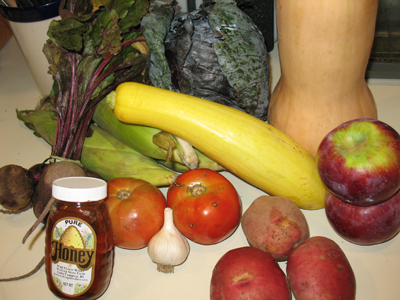
For those of you following along at home, so far, the CSA has beaten the store by a few dollars each week, on average. This week was no different, although something else interesting emerged. As someone who follows economics and politics on a nearly daily basis, it’s no surprise to me that prices go up. As things roll in and out of season, one would expect the prices of produce to fluctuate – a pear purchased in your town when it’s out of season SHOULD cost more, because you’re paying to get that pear from wherever they are in season. Still, the fluctuations are what interest me so much.
And, as back story, I can relate that I was spending part of my morning with my nose firmly implanted in my laptop’s screen, trying to find coupons from BJ’s, my grocery store (both for their store brand and name-brand items), Red Plum, and SmartSource. Of course, I know that coupons aren’t there for things that are dire needs; you can never get a coupon for milk (unless you’re buying cookies…sigh), and I have yet to see anyone offer coupons for produce. Best you can do, typically, is get a sale price that’s available only if you have the store’s rewards card. So, as I fished through the pages and pages of coupons on all of these sites, one thing really stood out to me: 99.9% of coupons are for crap. Now, I’m not saying this to be mean, I’m just being realistic. And yes, I have processed food in my house, so it’s not like I’m saying I never buy the crap. I’m just frustrated that this is all you can get coupons for.
I can save hundreds of dollars if only I would buy jerky bits and frozen faux Mexican fat bombs; I could be raking in the savings if I’d give my kids sugared-up juice or “kids” yogurt. And it all makes me shake my head. Do I feed my kids things out of boxes, cans & jars? Absolutely. Raising a kid without teaching them the joy that is eating an Oreo cookie with milk is just unfathomable to me. Still, I can’t imagine that every meal has to come out of some box. But it’s just not economical for some families, and then we’re back to the food deserts problem (which I’m sure I’ll rant about at some point).
So, then fast-forward to the point when I’m wandering the produce section, surreptitiously scribbling down the prices for the items that I had in my week 4 box. I didn’t notice until I got home that three of the prices had gone up. In two cases, the price difference between recorded store prices was as much as 50%! In other words, the store prices had gone up over the course of anywhere from 1-3 weeks (I’m not sure exactly when the prices shifted), and the difference was dramatic. For example, the week 2 price for beets was $1.99/bunch. The week 4 price for beets was $2.99/bunch. OK, it’s $1 more. Big deal, right? Well, what if you look at it another way: beets went up by $1 off a base price of nearly $2, meaning that the price increased by 50% in as little as two weeks. The same phenomenon was observed in the butternut squash (50% increase) and in the yellow squash (to a lesser extent – only a 25% increase).
Now, let me paint a picture for you: imagine that the price of the CSA box NEVER CHANGES from week to week. The $20 average price per box is sealed at sign-up. Once you have that sorted in your head, consider that the price of the produce at the store is not sealed. You pay as you go, and – as prices dip and soar – you have to absorb those as best as you can. It’s very similar to how airlines are flat out lying to you about how they had to raise fares THIS WEEK to cover some increase in the per-barrel price of oil; they buy what are called “futures” contracts, meaning they seal their gas costs in MONTHS in advance. This week’s ticket increase is paying for next year’s fuel, not what will get pumped into the plane you take tomorrow. (People who have oil heat and who lock their prices before the winter season know exactly what I’m talking about; that’s a futures contract on a smaller scale.)
And with all of that ranting done, allow me to present you the chart for this week’s CSA haul. Again, there was savings. This time, some of the savings was driven by the items (the honey isn’t cheap), and I also discovered that some of it was driven by the sudden increase in prices for beets, butternut squash and yellow squash.
| Week 4 CSA | |||||
| Weight (lb) |
Grocery Store Unit Price |
Grocery Store Total Item Cost | |||
| Tomatoes | 0.96 | $2.79 | $2.68 | ||
| Honey* (8oz jar) | 1.00 | $3.19 | $3.19 | ||
| Garlic | 0.07 | $2.99 | $0.21 | ||
| Yellow Squash | 0.95 | $2.49 | $2.35 | ||
| Purple Cabbage | 2.48 | $0.99 | $2.46 | ||
| Beets* | 1.00 | $2.99 | $2.99 | ||
| Cortland Apples | 0.80 | $1.59 | $1.27 | ||
| Butternut Squash | 3.77 | $1.49 | $5.62 | ||
| Corn** | 3.00 | $0.60 | $1.80 | ||
| Red Potatoes | 1.01 | $1.29 | $1.30 | ||
| Grocery Store Total Cost | $23.87 | ||||
| Week 4 Savings (Deficit) | $3.87 | ||||
| Program-to-Date Savings (Deficit) | $14.48 | ||||
| Notes: | |||||
| * Items are priced by the unit or bunch; I checked for rough equivalency (and they were close enough). | |||||
| ** Closest equivalent is husked corn cobs sold in 5pks; unit price was derived from this comparable item | |||||
So, what does this mean for someone trying to decide about whether to get into a CSA? Obviously, do your price comparisons with your local stores and see what you’re paying. Once you’ve done that, find out how your local CSA works and whether or not it’s a set price that you pay for N number of boxes. If you have a good handle on what things cost at your grocery store, and how their prices tend to move, then you can easily calculate the financial value. This has no bearing on the non-monetary considerations: taste, freshness, eating local, supporting local businesses, reducing pesticides and genetically modified foods in your diet, etc. Still, if you want to focus on financial value, I think I’ve shown that this is easy enough to quantify – and justify – at least for the CSA I’m in.
And what about where to buy your produce? The price increases (or decreases) that you see on any given week are a function of a number of different variables, including supply and demand. As with anything else where you are making a financial investment, I strongly recommend doing your research first. Ask people you know about the CSA programs they participate in – how much it costs, what you get, and whether or not you have to do any work to be a part of it. Keep an eye on the grocery store prices and don’t be afraid to track the numbers yourself. You don’t have to do it in Excel: just write down the prices on your grocery list while you shop, and do this every week for five or six things you know you always buy from the produce section, then write those prices down on a sheet of paper that you use to track everything. Eyeball the price changes and think about how they hit your wallet. An informed consumer is the most dangerous type of all, and luck rarely has anything to do with it. And if you don’t think this is a financial investment, consider that there’s more impact on your wallet from what you put down your gullet than you may think. If you eat healthier – fresher foods, with less processing – it can reduce the amount of salt, fat and toxins in your diet. Down the line, that can reduce the risk of various health problems.
So, you can consider yourself a financial investment. Or not. The choice is, as always, completely up to you.