Crock Pot Harvest Pork Tenderloin

The crock pot really gets going in the fall in our house; once it starts to get chilly out, we often start throwing in the beef stroganoff or some other fairly hearty dish. Trouble is, it’s often really heavy, too. There are times when I just don’t want a crock pot meal that weighs me down. CSA week 1 brought us sweet potatoes, so I decided to make a crock pot that capitalizes on those. Since we got apples, too, adding those into the mix seemed like a logical next step. And let’s toss in the red onion we got, as well! The more the merrier!

This crock pot meal meets most of my typical requirements: easy to prepare, cooks well, and doesn’t break the bank. If your grocery store does BOGO on pork tenderloin (which ours does on a semi-regular basis), consider picking up a couple and then freezing one. It only takes a day or so to thaw out a tenderloin, and you can save money while you eat a tasty dish.
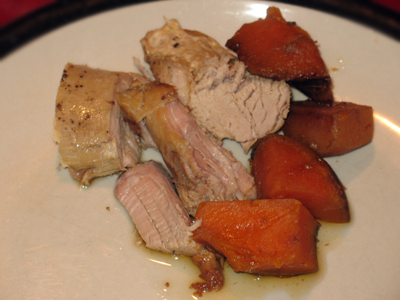
 

Crock Pot Harvest Pork Tenderloin

Welcome to Fall...


Prep Time: 10-15min

Cook Time: 6-8hrs on LOW (note: we let ours go for 11hrs and it was FINE)

Serves: 4-5


Ingredients

3 decent-sized sweet potatoes (about 1-1/3 lb), washed & chopped into ~1in pieces

2 small or medium macintosh apples, washed, cored & sliced

1 medium or large red onion, peeled & sliced

1-1/2 lb pork tenderloin

1/2 cup apple juice

2 Tb brown sugar

1 Tb cider vinegar

salt and pepper


Make it Happen

1. Coat the inside of a 5qt crock pot with non-stick spray.

2. Add the potatoes and onion to the crock pot. Place the pork on the bed of potatoes and onions.

3. Grind or sprinkle a small amount (each) of salt and pepper on top of the pork tenderloin. If using a grinder, a few grinds should do the trick.

4. Pour the apples on top of and around the pork tenderloin.

5. In a bowl, stir to combine the apple juice, brown sugar and cider vinegar. Once combined, pour over top of the items in the crock pot.

6. Cover and cook on LOW for 6-8hrs.

7. When done, remove the pork tenderloin from the crock pot and place on a cutting board to rest for 5-10 minutes.

8. Remove the potatoes, onions and apples and place in a serving bowl; remove the juices and put in a gravy boat or other easy serving vehicle. Slice the pork tenderloin into 1/2 – 3/4in slices, serve with the potato/onion/apple mixture, with sauce over top.

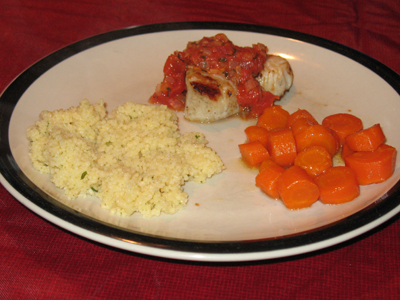
Grilled Scallops with Bruschetta

Oh Bruschetta. Whoever initially thought up the idea of bruschetta was on a par, intelligence-wise, with the person who thought to put peanut butter and chocolate together. What can you put bruschetta on, you might ask? The answer is: YES. During a stint with Weight Watchers, I learned that bruschetta can be a fantastic topping for baked potatoes – it’s lower in both fat and calories than my usual sour cream topping. Bruschetta on eggs? Yes. Crostini (maybe with a little parmesan on top)? OH MY YES. It’s just a miraculous and incredibly easy thing to make.

For the first week of my Adventures in CSA, I thought that pairing some of the tomatoes (in bruschetta form) with fresh sustainable (!) sea scallops from the grocery store would do the trick. The answer is: most indubitably YES. This was a massive win, and though I didn’t do the grilling (DH handled that task rather nicely), I ran the kitchen and had the stove happily bubbling.

The full dinner that night: Grilled Scallops with Bruschetta, Garlic & Parmesan Couscous, and Glazed Carrots. (Full disclosure: the couscous was the Near East boxed variety…it has high acceptance rates with the kids, but I don’t think adding something boxed diminished the meal in any way.)

Dinner: grilled sea scallops with bruschetta, garlic & parmesan couscous, and glazed carrots

Scallop Dinner. Yummy Yummy.

Can you make this dish with bay scallops? Probably – although I wouldn’t do them on the grill. Bay scallops are small enough that I’d probably just pan fry them instead. Sea scallops, especially the wild ones that are sustainably fished, can be really nicely sized for the grill.

My instructions below are based on the idea that you’re doing these together – so it’s all about timing to get things done at the same time. If you want to make *just* the bruschetta, figure on about 10 min of prep time to cut everything, and then another 10 min of cooking time.


Serves: 2-3

Prep: 30 min (marinating the scallops); 10 min (chopping for the bruschetta)

Cook time: 8-10 min (scallops); 10 min (bruschetta)


Ingredients: Grilled Scallops

1 lb sea scallops

1/4 cup extra virgin olive oil

2 Tb lemon juice


Ingredients: Bruschetta

1 large slicing tomato, diced

2 medium or large shallots, minced

1-1/2 Tb extra virgin olive oil

2 tsp lemon juice

1 tsp dried parsley

1 tsp dried cilantro

salt and pepper, to taste


Make it Happen

1. Rinse the scallops and place in a mixing bowl; add the olive oil and lemon juice noted above for the scallops. Marinate for 30 mins.

2. When you start the grill, start getting the bruschetta in the pan. Start by heating up the olive oil for the bruschetta in a medium non-stick skillet over medium heat. Add the shallots, and stir to coat them with the oil. Continue to let the shallots go on their own for about 1-2 mins.

3. Add the tomatoes to the pan, stir well to combine. Sprinkle or grind salt and pepper onto the mixture and stir again, only adding a small amount. (I use sea salt and black pepper grinders, and I did just a couple grinds of each.)

4. Get the scallops on the grill. Total scallop cook time should probably be about 8-10 minutes, but definitely check them for doneness before removing them from the grill. You’ll need to turn them half-way through cooking, so figure on turning them around the 4th or 5th minute of cooking.

5. Continue to stir the tomato/shallot mixture, looking to see that the amount of moisture released by the tomatoes will first boil and then start to cook off. Add the lemon juice earmarked for the bruschetta, as well as the parsley and cilantro. Stir to combine.

6. Continue to cook until the scallops are done or until the majority of the excess moisture is gone from the pan. Remove from heat.

7. When the scallops come off the grill, top with bruschetta.

My result looked like this:

Grilled Scallops with Bruschetta

So tasty...

The sugar released by the shallots combined with the rich flavor of the CSA tomatoes to make this probably the sweetest bruschetta I’ve ever had. I have made variations on this before, where I added garlic with the shallots, and that adds a nice tang that’s totally worth doing – but we were out of garlic (the horror!!), so I made do. And this definitely worked.

Adventures in CSA (week 1): I wasn’t expecting that…

So, the verdict on the price is in, specific to week 1.


Week 1 CSA
Weight (lb) Grocery Store Unit Price   (per lb) Grocery Store Total Item Cost
Yellow Squash 1.23 $1.99 $2.44
Corn 3.00 $0.60 $1.79
Carrots 2.55 $0.80 $2.04
Green Peppers 1.69 $1.49 $2.51
Macintosh Apples 2.42 $1.59 $3.85
Cucumber 0.61 $1.49 $0.91
Red Onion 0.91 $1.29 $1.17
Sweet Potatoes 1.39 $0.99 $1.38
White Potatoes 2.11 $1.29 $2.72
Tomatoes 1.85 $2.99 $5.54
Grocery Store Total Cost $24.35
         
  Savings (Deficit) $4.35

I really wasn’t expecting that. In fact, DH looked over my shoulder as I typed the numbers into my Excel spreadsheet, saying, “I think the grocery store will be cheaper.” After all, $1.49 here and $0.99 there, on a per-pound basis…it just seems like you’d save money, right? Economies of scale, anybody? So, color us both surprised that as I was a mere 4 entries from finishing the list and suddenly the gap between the cost of the CSA box ($20) and the cost of the comparable veggies from the grocery store shrank dramatically.

In this case, for this particular box, we saved $4.35 versus what we would have paid for comparable fruits and veggies at our store. That may not seem like a lot, but over the course of a year, assuming that you try to buy this general assortment of fruit and veggies per week – even for half of the year – that’s a potential savings of about $113. Go for a full year, and you’re over $200 in savings. Put another way, the CSA box this week represented a savings of about 18% versus the grocery store prices for the same items. Anybody else like the idea of saving 18% on their grocery bill?

How did we pick comparables? Easy enough – we went with what we’d typically buy or whatever was closest to the specific article. That means the price for the tomatoes is the price for the regular slicing tomatoes (not the more expensive organic kind), even though we would usually get the tomatoes on the vine (which are less expensive than the slicing kind).

A few more pricing caveats: the prices I see here in New England may vary from what you see. We do the bulk of our grocery shopping at a large regional chain, not at Whole Foods or Trader Joe’s. So, the prices I quote above are for this week, at our chain store. What you see and what you might pay at your own store could be more or less, depending upon all kinds of factors (quantity of local farms/distributors, regional margins or factors that influence prices, large vs small chain, “organic” vs “chain” store, etc.).

I’ll continue to track this through the 8-week run of this CSA, and you’ll see weekly savings (or deficits) and program-to-date numbers, since one week may be under and another week may be over. I can certainly say that my curiosity is more than piqued, thanks to this first week’s result.

Sorry if this is all a bit too geeky with the Excel and all, but as someone who’s always looking to trim our grocery bill and improve the overall health and quality of our eating habits, this is really fascinating stuff to me. Hopefully, it’s at least mildly interesting to others…